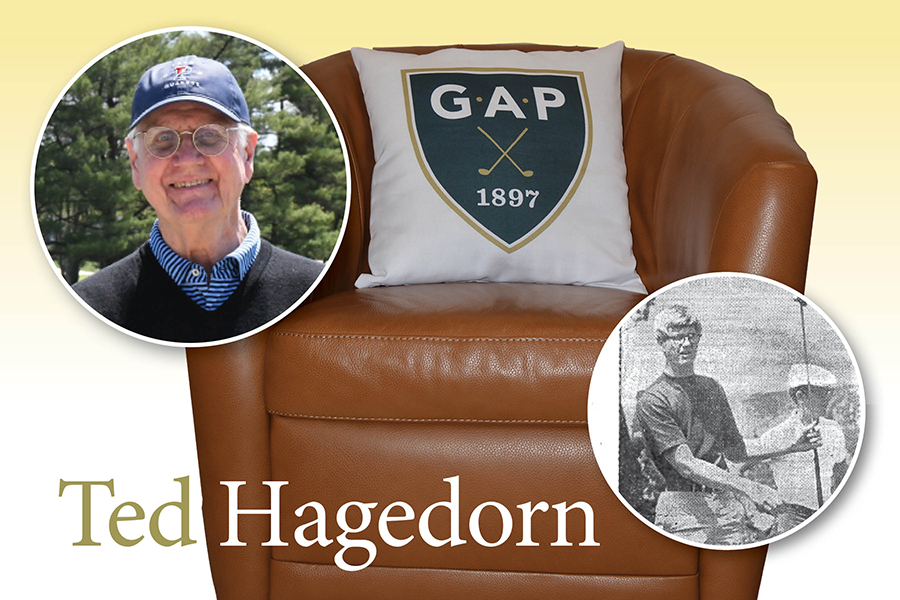

An enthusiastic Ted Hagedorn, at the age of 11, watched John Guenther, Jr. defeat Lincoln Roden, III in the 1960 Philadelphia Amateur Final.
“This is pretty cool,” he thought. The competitive golf seed planted that day at Huntingdon Valley Country Club.
“By 12, I was breaking 80,” Hagedorn, 77, of Ambler, Pa., said. “My dad (Herman) did a lot to foster opportunities for young players. He started a junior golf tournament that invited players from the tri-state area. He ran the event for seven years at Melrose [Country Club]. I had great fun playing as a kid at Melrose. We had a junior team where all seven guys would regularly break 80.”
At age 15, Hagedorn won the men’s club championship at Melrose. He eliminated 1953 Philadelphia Amateur Champion Dick Allman along the way.
Seeking full golf privileges as a junior, Hagedorn joined Old York Road Country Club in 1965 and represented the club in the BMW GAP Team Matches for the next 40 years. His move to OYR coincided with a run to the Junior Boys’ Championship Final. Hagedorn ousted Eric Stevenson, Andy Thompson and Bob Lange before falling to Ed Marshall, III.
“I had nothing left. It was 98 degrees that whole week. I might have been 150 lbs. at the start of the week, and I was certainly a lot less at the end. And Ed beat me,” Hagedorn said. “He could hit a golf ball just as well standing on one foot, where he demonstrated to me a few times at Old York Road. Good guy.”
An Olney High School graduate, Hagedorn represented GAP in the Williamson Cup and qualified for the U.S. Junior Amateur in 1965 and 1966. Also, in 1966, he won the individual title in the Philadelphia Public League Championship. Hagedorn attended the University of Pennsylvania, but left after two years. He struggled with hyperglycemia (high blood sugar), fatigue and an inability to focus among the effects.
“It wasn’t working out. My game had gone south. School was difficult. I didn’t understand why I was having so much trouble reading,” he said.
Buoyed by a high protein diet, a rejuvenated Hagedorn put his stamp on the 1969 Philadelphia Amateur. He earned medalist honors at Cedarbrook Country Club and OYR, edging GAP Hall of Famer R. Jay Sigel by a stroke. Friend and 1968 Amateur runner-up Andy Goldman drove Hagedorn to Cedarbrook for match play the following day. Hagedorn dispatched Goldman, 5&4, in the Round of 32. He faced good friend and GAP Hall of Famer Dave Brookreson in the Round of 16. Brookreson prevailed, 1-up. Then he gave Hagedorn a ride home.
Another “close but no cigar” occurred that year in the Francis Hoffner Invitational, a renowned better-ball-of-partners event at Sandy Run Country Club. Hagedorn and Tony Valentine led entering the final hole, a par 4 with treacherous out of bounds right. Guess where their tee shots went?
“I like to say that I pushed it right a little bit. Tony hit the clubhouse both times and walked straight to the parking lot,” Hagedorn said. “So, I finished the hole by myself, figuring fifth place might win a pair of shoes.”
Despite the results, Hagedorn’s game seemed to be in a great place. Looks can be deceiving. In 1970, Hagedorn failed to qualify for match play in the Philadelphia Amateur. In the qualifying round at Concord Country Club, he hit 15 greens in regulation, made two par saves and shot 80.
“I just couldn’t get the ball in the hole. My putting struggles really surfaced a lot,” Hagedorn, who managed Burholme Billiards for two years, said. “What’s wrong with you if you’re a really good pool player and can’t putt? It’s the element of the nerves.”
Competitive golf receded. Hagedorn returned to school, graduated from Temple University in 1978 and started an accounting career as an auditor. An influx of firepower at Old York Road — Gary Deetscreek, Jack Hubert, Nevin Sutcliffe and John Truax — started to shift Hagedorn’s golf mindset. When Michael Brown joined the club, the two became good friends and regulars on the course. In 1983, Hagedorn represented Old York Road in the Philadelphia Team Championship. He watched Wayne Hardin of Manufacturers’ Golf & Country Club use a long putter, sidesaddle style, that year. Old York Road, led by Hagedorn, won. More importantly, golf won Hagedorn back. He switched to a long putter.
“That was a watershed event for me. It kept me in the game. My putting was so problematic. It was not fun anymore,” Hagedorn said. “The next week at Old York Road, [using a conventional putter] I missed a five-footer for birdie on No. 1 and a three-footer for par on 2. Enough with that. From then on, I putted sidewinder.”
With renewed confidence, Hagedorn returned to the Philadelphia Amateur in 1985. He lost to James Robertson in 21 holes in the Round of 32. A year later, Hagedorn again cracked the match-play bracket. He fell to future GAP Hall of Famer Blaise Giroso, 7&5, in the Round of 16.
In 1987, Hagedorn married his wife Lizanne. Family followed. Work as a tax professional and time with daughters Katie, Elle and Jenevieve became a priority. But golf always finds a way.
“I have a renewed interest in the game,” Hagedorn said. “My friend John Carson was complaining to me that his wife threw out his Ben Hogan tapes. And I said, ‘Jeez you ought to be able to go on YouTube and look at Ben Hogan videos.’ Next thing you know I’m on YouTube looking at Ben Hogan videos. I’m looking at Moe Norman videos. I’m looking at everything.
“I enjoy the game. My ball striking today is way more consistent and solid than it was for many years. I sort of got lost in the wilderness. Now, when I do play, I hit the ball pretty well.”
Chat GAP
Chat GAP, formerly known as the Legends Video Series and GAP Chat, features tournament players and supporters recalling their GAP experiences. It is a GAPTV video production.
GAP
Celebrating Amateur Golf since 1897, GAP, also known as the Golf Association of Philadelphia, is the oldest regional or state golf association in the United States. It serves as the principal ruling body of amateur golf in its region. The organization’s 345 Member Clubs and 130,000 individual members are spread across Pennsylvania, Delaware, New Jersey and Maryland. The GAP’s mission is to promote, preserve and protect the game of golf.